

The History of Essiac in Canada
How does a humble botanical blend from the 1920s remain a respected global standard a century later? When you're searching for the truth about this traditional formula, it's easy to feel overwhelmed by conflicting stories and modern imitations. You likely want to ensure you're following the path of the original recipe without the distraction of unverified claims. This article clarifies the documented essiac history, providing a clear timeline of Rene Caisse's work and the transition of her authentic formula into the modern era.
You'll gain a firm understanding of the 1922 origins in Ontario and the specific botanical profile of the four herbs used in the traditional blend. We'll walk through the key moments that defined this Canadian legacy, helping you identify the authentic standard with confidence. From the early days of the Bracebridge clinic to the preservation of the original ratios, this guide serves as a faithful steward of the facts you need to know. By looking at the documented archives, you can better appreciate the care taken to keep this heritage intact for future generations.
Key Takeaways
- Learn about the documented 1922 encounter between Rene Caisse and a patient that introduced the traditional botanical blend to the public.
- Identify the four specific plants—Burdock root, Sheep sorrel, Slippery elm bark, and Indian rhubarb root—that comprise the authentic recipe.
- Trace the timeline of the Bracebridge clinic and the preservation of the formula through historical archives and verified facts.
- Understand how documented essiac history ensures the authenticity of modern tea, capsule, and extract formats available today.
The Origins of the Essiac Formula in the 1920s
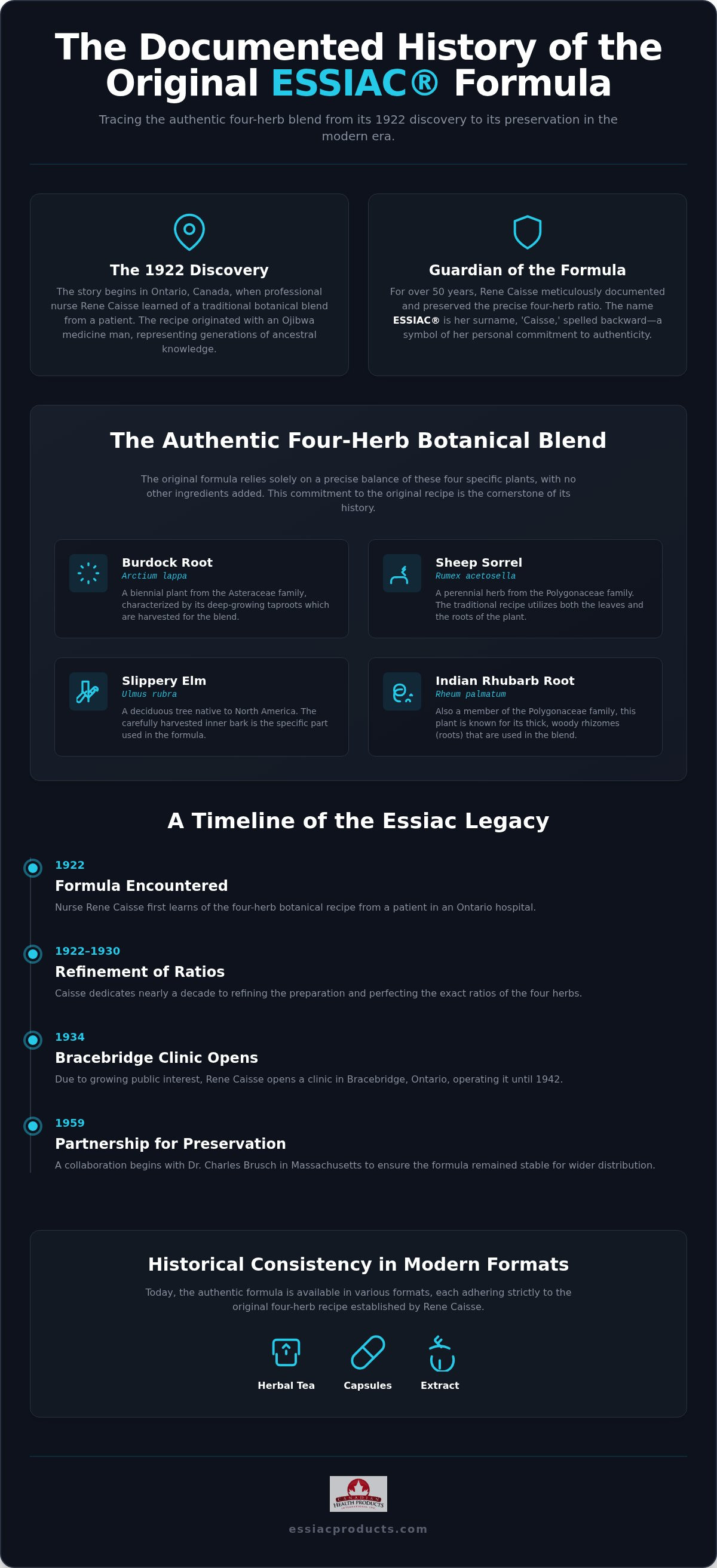
The documented essiac history begins in 1922 within a hospital in Ontario, Canada. Rene Caisse, a professional nurse, encountered a patient who had utilized a specific botanical blend decades earlier. This patient shared the story of an Ojibwa medicine man who had provided a combination of local herbs. Understanding the importance of this encounter is central to grasping the full essiac history and its Canadian roots. Recognizing the potential of this traditional knowledge, Rene Caisse dedicated herself to preserving the recipe, eventually moving it from a personal discovery to a recognized standard in herbal tea.
Rene Caisse: The Steward of the Formula
Rene Caisse acted as a faithful guardian of this botanical heritage for over fifty years. She meticulously documented the specific ratios of the four primary herbs: Burdock root, Sheep sorrel leaves, Slippery elm bark, and Indian rhubarb root. Her commitment wasn't just to the ingredients themselves but to the precise measurements that ensured consistency. By focusing on these exact proportions, she established a legacy of authenticity that remains the foundation of the Essiac tea available today.
The Naming of Essiac
The name itself serves as a direct link to its founder's identity. It's an anagram of Rene's surname, "Caisse," spelled backward. This branding was a deliberate step to distinguish her specific four-herb ratio from other herbal mixtures. Today, identifying the trademarked name is essential for anyone seeking the original Canadian formula. It represents a century of tradition and a commitment to the standards Rene Caisse first established in the 1920s. This history provides a clear path for those who value transparency and time-tested botanical blends over modern imitations.
The Traditional Four-Herb Botanical Blend
Authenticity in the context of essiac history is defined by the specific four-herb ratio established by Rene Caisse. While modern imitations often add extra ingredients to create a more complex profile, the original formula relies solely on a precise balance of roots, bark, and leaves. Maintaining this historical integrity ensures that the botanical profile remains consistent with the 1922 discovery.
Botanical Components: Burdock and Sheep Sorrel
Burdock root (Arctium lappa) is a biennial plant from the Asteraceae family. It's characterized by its large, heart-shaped leaves and deep-growing taproots that anchor it firmly in the soil. These roots are harvested for their dense botanical properties and earthy characteristics. Sheep sorrel (Rumex acetosella), a member of the Polygonaceae family, is a smaller perennial herb. It features distinct arrow-shaped leaves and small, reddish-brown flowers. In the traditional blend, the leaves of the sheep sorrel are utilized, reflecting the ancestral knowledge shared with Nurse Caisse in Northern Ontario.
Botanical Components: Slippery Elm and Indian Rhubarb
Harvesting the inner bark of the Slippery elm (Ulmus rubra) provides a key component for the traditional recipe. This deciduous tree is native to North America. The inner bark is the specific part used. It requires careful harvesting to preserve the tree's health. The bark has a distinctive fibrous texture when dried and prepared. Indian rhubarb root (Rheum palmatum) also belongs to the Polygonaceae family. It's known for its thick, woody rhizomes. This plant produces large, palmate leaves and tall flower stalks. The inclusion of these four specific plants, and nothing more, is what defines the authentic four-herb formula. Each ingredient is selected for its unique botanical characteristics, ensuring the legacy of the original recipe remains a cornerstone of essiac history.
A Timeline of the Essiac Legacy
The timeline of essiac history is a journey of careful preservation and steady growth. Between 1922 and 1930, Rene Caisse focused on personal distribution, refining the preparation of the four-herb blend in her own kitchen. She didn't just share the recipe; she spent that decade perfecting the exact ratios of Burdock root, Sheep sorrel, Slippery elm bark, and Indian rhubarb root. By 1934, public interest led to the opening of her clinic in Bracebridge, Ontario. She operated this facility until 1942, providing the traditional tea to thousands of individuals who valued her dedication to botanical authenticity.
Preserving the Canadian Heritage
The formula remains deeply rooted in its Canadian origins, a fact that distinguishes the authentic recipe from modern imitations. Eventually, Rene Caisse transferred the proprietary rights to the formula to ensure its global availability while protecting its historical standards. Today, Essiac Canada International serves as the faithful steward of this tradition; it's a 100-year-old legacy. They maintain the exact ratios established in the 1920s, providing a stable and reliable source for the traditional formula. To experience the authentic blend preserved through this documented history, you can view the original Essiac tea collections directly from the source.
Historical Consistency in Modern Formats
The transition from the 1922 discovery to modern usage requires a careful balance between convenience and tradition. While the original method involved a lengthy brewing process, the core of essiac history lies in the specific botanical ratios, not just the preparation style. Whether you choose the traditional tea or a modern format, the integrity of the four-herb blend remains the priority for those seeking the authentic Canadian experience. This consistency ensures that the 100-year-old legacy is preserved regardless of how the herbs are delivered.
The Evolution of the Essiac Extract Supplement
Liquid extract offers a practical alternative for those who can't commit to the hours required for brewing and cooling the traditional tea. The extract is designed to mirror the botanical profile of the original recipe in a concentrated form. By using the Essiac Extract Formula, you maintain the historical standards Rene Caisse established without the extensive preparation time. This format ensures that the botanical integrity is preserved through modern extraction methods that respect the legacy of the 1920s. It provides a shelf-stable option that remains faithful to the ancestral ratios established in Ontario.
Capsules and Powders: Modern Convenience, Traditional Roots
For those who prefer a portable option, the development of Essiac Vegetable Capsules represents a significant milestone in the formula's timeline. These capsules contain the same four herbs in their dried, powdered form, ensuring that the ratio of roots, bark, and leaves stays consistent with historical records. Identifying the authentic label is the final step in ensuring your choice aligns with the documented essiac history. By looking for the trademarked name and verified Canadian origin, you can be sure the product reflects the original 1922 discovery rather than a modern imitation.
Preserving a Century of Botanical Tradition
Understanding essiac history allows you to navigate modern options with clarity. From the 1922 encounter in Ontario to the standards of the Bracebridge clinic, the value of this formula lies in its documented consistency. By focusing on the authentic four-herb ratio, you're choosing a botanical blend that has remained unchanged for over a century. This dedication to the original recipe ensures you aren't distracted by imitations that add unnecessary ingredients or make unverified claims.
Whether you prefer the traditional long-brew tea or the convenience of vegetable capsules and liquid extracts, the botanical integrity remains the same. As the official steward of the Rene M. Caisse formula, Essiac Canada International preserves this authentic four-herb blend in tea, capsule, and extract formats for families worldwide. You can Shop the Authentic Essiac Formula from Canada to bring this time-tested tradition into your own home. Trusting in a documented legacy provides peace of mind as you prioritize your daily care with sincerity and confidence.
Frequently Asked Questions
Who was the nurse responsible for the Essiac formula?
Rene M. Caisse was the Canadian nurse who popularized the formula after encountering a patient in 1922. She spent over fifty years dedicated to providing the herbal blend and documenting its specific ratios. As a faithful steward of this knowledge, she ensured the traditional recipe remained consistent. Her work in the clinic established the foundation for what is now a recognized global standard in botanical teas.
What are the original four herbs in Essiac tea?
The authentic recipe consists of exactly four herbs: Burdock root (Arctium lappa), Sheep sorrel (Rumex acetosella)leaves, Slippery elm bark (Ulmus rubra), and Indian rhubarb root (Rheum palmatum). These specific botanical components were selected for their unique characteristics and are combined in a precise ratio. Maintaining this specific four-herb profile is essential for historical accuracy. Original essiac history confirms that Rene Caisse didn't include additional plants or fillers in her traditional formula.
Where did the name Essiac originate from?
The name Essiac is an anagram derived from the surname of its founder, Rene Caisse, spelled backward. This branding was a deliberate choice to identify her specific four-herb botanical blend as the authentic standard. By using her own name in reverse, she created a lasting identity for the formula she spent decades preserving. Today, the trademarked name serves as a vital indicator of authenticity for those seeking the original Canadian recipe.
Is the Essiac formula still made in Canada today?
Yes, the authentic formula is still produced in Canada by Essiac Canada International, which holds the proprietary rights to the Rene M. Caisse recipe. The company preserves the 100-year-old legacy by following the exact ratios and sourcing standards established in the 1920s. This commitment to Canadian origins ensures that the botanical integrity of the traditional blend remains intact for customers worldwide who value the original four-herb standard.
What is the difference between the original formula and modern imitations?
The primary difference lies in the specific four-herb ratio and the exclusion of additional botanical ingredients. Many modern imitations add extra herbs, such as watercress or kelp, which weren't part of the original discovery. Documented essiac history emphasizes that the authentic blend relies solely on the four specific plants Rene Caisse utilized. Choosing the original proprietary formula ensures you're receiving the same ratio preserved since the early years in Canada.