

Who Was Rene Caisse? The Canadian Nurse Behind Essiac
The legacy of a single Canadian nurse remains the definitive standard for a botanical tradition that has endured for nearly a century. For those seeking clarity, the story of Rene Caisse offers a grounded perspective on the faithful preservation of historical knowledge. It's common to feel a sense of confusion when encountering various versions of her formula, especially when so many modern products claim to be the original without providing context. You deserve to understand the documented history of the woman who dedicated her life to this work in Bracebridge, Ontario.
In the following sections, you'll discover the biography of Rene Caisse and the history behind the traditional four-herb formula she popularized throughout Canada. We'll identify the specific botanical characteristics of Burdock root, Sheep sorrel, Slippery elm bark, and Indian rhubarb root that comprise the authentic blend. We'll also help you identify the official steward of her legacy to ensure you can locate the authentic source. By examining verified archives, we'll move past the anecdotes to understand the true heritage of Essiac.
Key Takeaways
- Learn about the life of Rene Caisse, the Canadian nurse from Bracebridge who dedicated her career to preserving a specific botanical ratio.
- Identify the four specific herbs that comprise the authentic formula and learn how their botanical characteristics define the traditional blend.
- Trace the historical stewardship of the formula to recognize the authorized source of the original Canadian-made product.
- Compare the preparation requirements for tea, capsules, and extracts to help you maintain a consistent and accurate routine.
The Life and Nursing Career of Rene Caisse
Rene Caisse was born in 1888 in Bracebridge, Ontario. She spent much of her life working as a professional nurse, a role that defined her disciplined approach to botanical research. During the mid-20th century, her dedication to her community in the Muskoka region became the foundation for what many recognize today as a significant piece of Canadian heritage. She wasn't just a collector of traditions; she was a trained professional who maintained rigorous standards in her work, ensuring that every preparation she made followed a precise and consistent methodology.
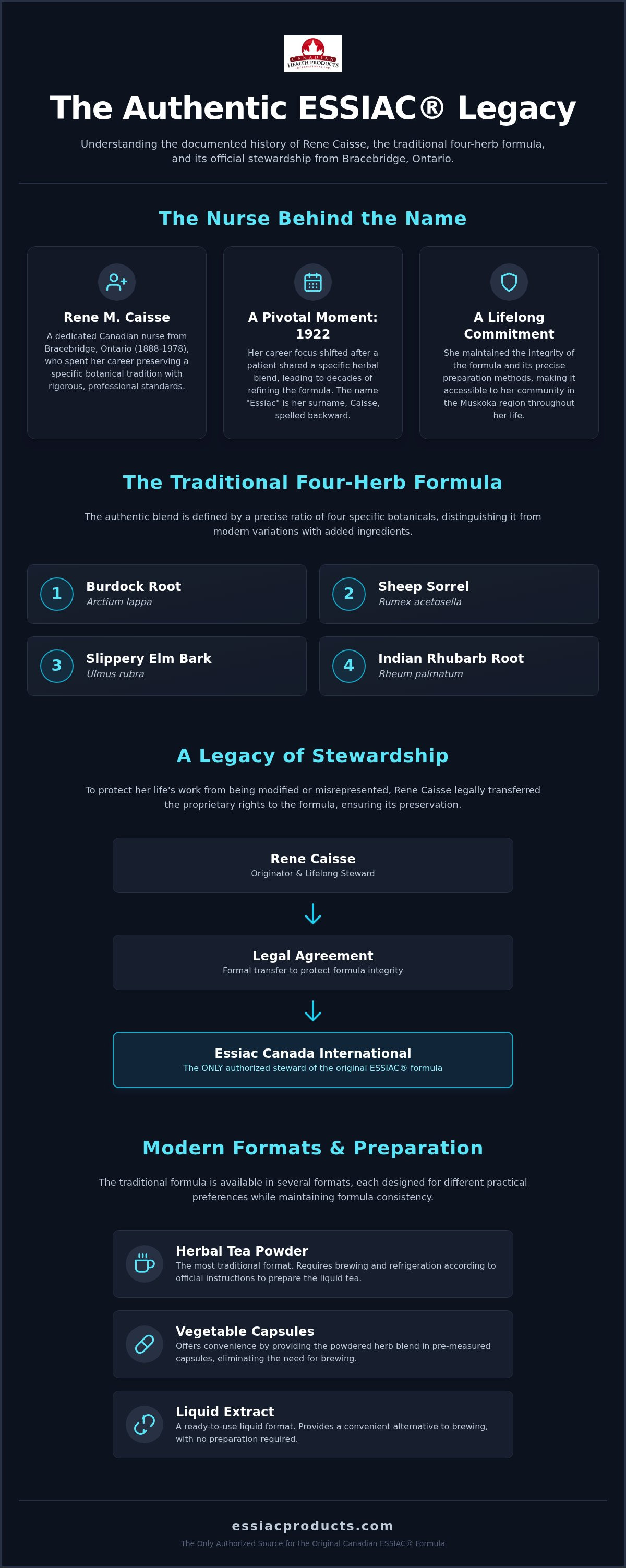
A pivotal moment occurred in 1922 when she met a patient who shared a specific herbal blend. This encounter changed the trajectory of her career. She spent the following decades refining and distributing this four-herb formula to those who sought it. To honor her work while maintaining a level of professional humility, she chose a unique name for the blend. The name "Essiac" is simply her own last name, Caisse, spelled backward. This historical connection between Rene Caisse and Essiac remains a central part of the formula's identity and provenance.
A Legacy Rooted in Bracebridge, Ontario
Bracebridge served as more than just a birthplace; it was the site of her clinical work for many years. From the 1920s until her passing in 1978, she operated with a deep-seated empathy for those who asked for her assistance. Her nursing background ensured that the distribution of the formula was handled with care. She remained a faithful steward of this knowledge, choosing to stay in Ontario to oversee the integrity of the formula she popularized.
Key aspects of her professional life included:
- Adherence to traditional botanical preparation methods to ensure consistency across every batch.
- A life-long commitment to making the formula accessible to her community.
- The preservation of a specific ratio of herbs that remains the standard for the original formula today.
The Traditional Four-Herb Essiac Formula
The foundation of the traditional blend is a precise ratio of four primary botanical ingredients. Rene Caisse spent decades refining this specific combination, ensuring that each component was sourced and prepared according to exact standards. This four-herb profile distinguishes the authentic formula from modern variations that often add unnecessary fillers or alter the original proportions. It's this commitment to a specific botanical balance that has allowed the tradition to persist for nearly a century.
Botanical Characteristics of the Blend
The four herbs each belong to distinct plant families and offer unique physical profiles. Burdock Root (Arctium lappa) is a biennial plant in the Asteraceae family, recognized for its deep taproots and broad, heart-shaped leaves. Sheep Sorrel (Rumex acetosella) is a hardy perennial in the Polygonaceae family with characteristic arrow-shaped foliage. The blend is completed by the inner bark of the Slippery Elm (Ulmus rubra) and the robust root of Indian Rhubarb (Rheum palmatum). Sourcing these ingredients at their peak maturity and ensuring they are processed correctly is vital for matching the quality levels established in the early 20th century.
Maintaining Formula Integrity
Maintaining the integrity of the formula requires strict adherence to the ratios Rene Caisse developed. While the market features several versions of herbal blends, many of these are eight-herb mixtures that deviate from the documented four-herb tradition. For those focused on historical authenticity, the four-herb ratio remains the only version tied directly to the Bracebridge clinic. Each herb must be present in the correct amount to ensure the final product reflects the heritage of the original blend. This precision ensures that the botanical characteristics of the roots and barks are balanced exactly as they were during the mid-20th century. If you're looking to follow the traditional brewing method, choosing the authentic four-herb tea is the most direct way to honor this legacy.
Stewardship: From Rene Caisse to Essiac Canada International
The preservation of the four-herb formula required a deliberate transition from a personal mission to a structured organization. Rene Caisse was deeply concerned that her life's work would be modified or misrepresented after her passing. She didn't want the ratios she worked so hard to perfect to be lost to history. To prevent this, she entered into a legal agreement to transfer the proprietary rights of the formula. This step ensured the traditional ratio remained intact for future generations.
Today, Essiac Canada International stands as the only authorized steward of this botanical legacy. This legal succession is a critical detail often overlooked by those researching the formula's history. Some modern sources suggest the original recipe was lost or modified over time, but the legal chain of custody tells a different story. Verification of an authentic product involves looking for specific trademarks and confirming the Canadian origins. Since the formula was developed in Bracebridge, Ontario, maintaining production within Canada is essential for honoring its heritage.
Protecting the Proprietary Rights
Moving from a small clinic to international distribution required rigorous standards. Every batch must adhere to the precise preparation methods Rene Caisse established in the early 20th century. Historical archives and institutional records have documented the context of her work, providing a bridge between her traditional methods and modern records. Manufacturing isn't just about mixing herbs; it's about following the exact steps of boiling and steeping that Caisse practiced. By acting as a guardian of these methods, the company ensures that the product available today is identical to the one distributed in her clinic. If you want to experience the result of this careful stewardship, you can find the original four-herb formula here.
Modern Formats and Practical Preparation
While Rene Caisse originally popularized the four-herb formula as a brewed tea, modern preparations have evolved to suit different lifestyles. The core ratio of the botanical blend remains the same, but the delivery method can vary based on your personal preference for convenience or tradition. Available formats include:
- Traditional Tea Powder: For classic brewing and steeping.
- Vegetable Capsules: A non-gelatin, shelf-stable option.
- Liquid Extract: A concentrated format that requires no preparation.
- Pet-Specific Capsules: Tailored for domestic animals.
Brewing and Storage Instructions
The traditional method requires preparing the Essiac Tea Powder by boiling it in water and allowing it to steep for several hours according to the official label directions. Once brewed, the tea must be stored in a sterilized glass container within the refrigerator. Because the formula contains no artificial preservatives, following these storage requirements is vital to maintain its freshness. The shelf life of the brewed liquid is limited, so brewing in smaller, frequent batches is often the most practical approach for individual use.
Choosing the Right Format for Your Routine
Selecting a format depends largely on your schedule. The traditional tea offers a classic experience, but it requires a commitment to the brewing and cooling process. For those who travel or lead busy lives, Essiac Vegetable Capsules provide a portable alternative that removes the need for refrigeration. Another option is the Essiac Extract, which provides the formula in a liquid state without the time required for brewing. Each of these formats upholds the standards established by Rene Caisse, ensuring the heritage of the four-herb blend is preserved. Additionally, Essiac for Pets allows you to provide the same traditional ratio to your animals in a convenient capsule form. Consistency in your chosen routine is the most important factor for long-term use.
Honoring a Century of Botanical Heritage
Understanding the life of Rene Caisse helps clarify the distinction between modern imitations and the authentic four-herb formula. Her work in Bracebridge, Ontario, established a standard for botanical preparation that remains the definitive guide for this Canadian tradition. By focusing on the documented history and the specific ratios of Burdock root, Sheep sorrel, Slippery elm bark, and Indian rhubarb root, you can ensure your routine aligns with the original standards she perfected.
As the proprietary rights holder, Essiac Canada International continues to act as a faithful steward of this knowledge. Whether you prefer the traditional brewing of tea or the convenience of vegetable capsules and extracts, the commitment to authenticity remains unchanged. Selecting a format that fits your daily schedule is the most effective way to maintain consistency. We invite you to shop the authentic Essiac formula collection to find the preparation that best supports your needs. It's an enduring legacy that's now yours to explore with confidence and clarity.
Frequently Asked Questions
Who exactly was Rene Caisse?
Rene Caisse was a professional Canadian nurse born in 1888 who spent her life working with a specific botanical formula. After receiving the tradition in the early 1920s, she managed a clinic in Bracebridge, Ontario. She's the central figure in the formula's history, having spent years ensuring its correct ratio was preserved. Her commitment to her community defined her professional legacy and the standards for the blend today.
What are the four herbs in the original Essiac formula?
The authentic formula consists of exactly four botanical ingredients: Burdock Root (Arctium lappa), Sheep Sorrel (Rumex acetosella) leaves, Slippery Elm Bark (Ulmus rubra), and Indian Rhubarb Root (Rheum palmatum). These specific herbs must be combined in the precise ratio developed by Rene Caisse to maintain the integrity of the original tradition. While other modern mixtures may include additional herbs, only this four-herb blend is recognized as the traditional Canadian formula.
How did the name 'Essiac' originate?
The name is a simple but clever reversal of the developer's last name, Caisse. By spelling her name backward, she created a unique identifier for the botanical blend that honored her work while maintaining a professional distinction. This naming convention's helped protect the heritage of the formula, making it easier for individuals to identify the specific four-herb ratio that originated in Ontario.
What is the difference between Essiac tea and capsules?
The primary difference lies in the method of preparation rather than the botanical ratio itself. The traditional tea is a powder that you must brew and refrigerate. In contrast, the vegetable capsules offer a convenient, shelf-stable alternative that requires no boiling. Both formats use the same four-herb blend, so you're able to choose the delivery method that best fits your schedule and lifestyle requirements.