

What is in Essiac Tea? A Complete Guide to Its History, Ingredients and Formats
ESSIAC® is made from a traditional four-herb blend of burdock root, sheep sorrel, slippery elm bark and Indian rhubarb root. Although many herbal blends are sold online under the Essiac name, authentic ESSIAC® is defined by its specific ingredients, Canadian history and connection to Rene Caisse. This guide provides the clarity you need by detailing the specific essiac tea ingredients that comprise the traditional four-herb recipe and the documented history behind them.
We'll examine the botanical characteristics and plant families of Burdock root, Sheep sorrel, Slippery elm bark, and Indian rhubarb root. By understanding these individual plants and the legacy of Canadian nurse Rene Caisse, you can move forward with confidence in your knowledge of this time-tested formula. We'll also look at the various formats available today, from traditional powders to modern vegetable capsules, to help you understand how this legacy continues in a contemporary context.
Key Takeaways
- Identify the four traditional essiac tea ingredients—Burdock root, Sheep sorrel, Slippery elm bark, and Indian rhubarb root—which form the authentic ratio of the original formula.
- Trace the historical timeline of the formula from its 1920s popularization by Rene Caisse to its origins in traditional knowledge shared by an Ontario healer.
- Gain clarity on the botanical profiles and plant families of each herb, such as the Arctium lappa (Burdock root) and Rumex acetosella (Sheep sorrel).
- Understand the practical differences in preparation and storage between traditional tea brewing and modern formats like vegetable capsules and extracts.
The Traditional Four-Herb Composition of Essiac
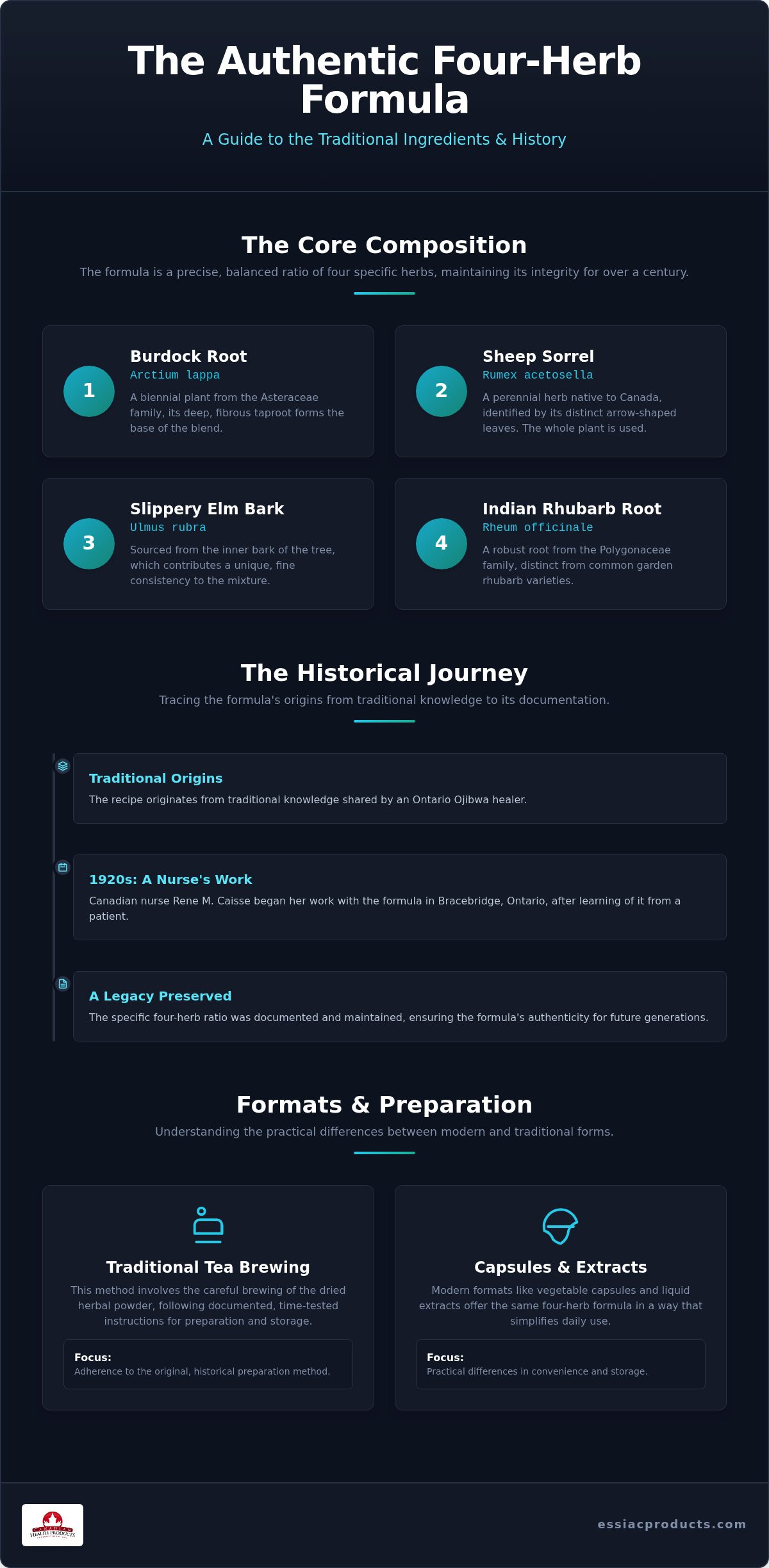
The authenticity of the formula rests on a specific botanical foundation. Since Rene Caisse began her work in the 1920s, the recipe has remained a precise combination of four specific plants. These essiac tea ingredients weren't chosen at random; they represent a carefully balanced ratio designed to maintain the integrity of the original Canadian tradition. Each component brings its own unique botanical profile to the blend, creating a finished product that is consistent in both appearance and character.
The traditional blend consists of these four specific herbs:
- Burdock root (Arctium lappa)
- Sheep sorrel (Rumex acetosella)
- Slippery elm bark (Ulmus rubra)
- Indian rhubarb root (Rheum officinale)
Why the Four-Herb Ratio Matters
The legacy of this blend is documented throughout the history of Essiac tea. Maintaining the specific ratio of these herbs is vital because the formula relies on the interaction between roots, bark, and leaves. Using the correct plant parts is just as important as selecting the herbs themselves. For instance, the use of whole-plant sheep sorrel including the leaves, is a hallmark of the traditional preparation. You can find this authentic blend in our Essiac Tea Collection, which adheres strictly to these historical standards.
Identifying Genuine Ingredients
When you examine a high-quality, dried herbal blend, you'll see a distinct range of textures and colors. The Burdock root and Indian rhubarb root provide a fibrous, earthy base, while the Slippery elm bark adds a lighter, slightly stringy consistency. Authentic sourcing ensures that these plants are harvested at the peak of their seasonal cycles. This meticulous attention to detail prevents the dilution of the formula and ensures every batch reflects the standards established over a century ago. Trusting the traditional essiac tea ingredients allows you to connect with a legacy that has remained unchanged for decades.
Botanical Profiles: Understanding the Plant Ingredients
Identifying the specific plants used in the traditional formula requires an understanding of their botanical classification. The essiac tea ingredients are derived from four distinct families and specific plant parts, ranging from deep taproots to delicate inner bark. Each plant is selected based on its unique characteristics and historical presence in North American traditions.
Arctium Lappa and Rumex Acetosella
Burdock root, or Arctium lappa, is a member of the Asteraceae family. It's a biennial plant that develops a deep, thick taproot during its first year of growth. The roots are harvested when they're firm and fibrous, typically showing a brownish-grey exterior and a white interior. Sheep sorrel (Rumex acetosella) is a perennial herb characterized by its arrow-shaped leaves and acidic profile. It's native to the Canadian landscape and thrives in various soil types. The NCI patient summary provides a breakdown of these botanical components within the context of historical research. For those following the traditional recipe, including the root of the sheep sorrel is often considered essential for authenticity.
Ulmus Rubra and Rheum Palmatum
Slippery elm bark (Ulmus rubra) is sourced from the inner bark of the tree. This material is carefully harvested to ensure the tree continues to grow, focusing only on the slippery layer beneath the rough outer bark. When dried and ground, it contributes a unique, slightly stringy texture to the blend. Indian rhubarb root (Rheum palmatum) belongs to the Polygonaceae family. It's a robust root that's distinct from the common garden rhubarb varieties used in cooking. When processed, it often displays a vibrant yellow or orange color. Each of these essiac tea ingredients must be sourced with care to maintain the standards of the original 1920s formula. You can explore these components in their traditional preparation through our authentic tea selection.
The Historical Journey of the Rene Caisse Formula
The history of the formula begins with Rene M. Caisse, a Canadian nurse who brought the blend to public attention in the 1920s. Living and working in Bracebridge, Ontario, she first encountered the recipe through one of her patients. This individual shared that the specific essiac tea ingredients and their precise preparation originated from an Ojibwa healer. Caisse realized the importance of this knowledge and spent the rest of her life refining and protecting the proportions. The name "Essiac" is a direct tribute to her legacy, as it's simply her surname spelled backward.
Rene Caisse and the Ontario Legacy
Caisse's dedication to the formula was both methodical and focused. Throughout the mid-1900s, she worked to ensure the four-herb recipe remained consistent and true to its origins. Her time in Ontario is well-documented, showing a clear path from a private recipe to a broader community tradition. This history explains why the specific selection of essiac tea ingredients is still held to such high standards today.
From Tradition to International Distribution
Standardizing production was a necessary step to ensure global accessibility. While the recipe started in a local setting, its reach expanded as more people sought the authentic Canadian blend. Essiac Canada International now acts as the steward of this 1920s legacy, ensuring modern production meets historical requirements. This transition has preserved the formula for future generations without compromising the original ratios. You can experience this documented heritage by choosing from our authentic Essiac tea collection.
Comparing Modern Essiac Formats and Preparation
The authentic 1920s recipe remains the standard for quality, but the delivery methods have evolved to suit modern lifestyles. While the traditional four-herb blend is most often associated with a brewed drink, you can now find these same essiac tea ingredients in formats that prioritize convenience and shelf stability. Choosing the right format depends largely on your daily routine and storage capabilities.
Tea vs. Capsules: Convenience and Storage
The traditional method utilizes Essiac Tea Powder, which requires a specific boiling and steeping process. This time-honored preparation ensures the botanicals are fully integrated into the liquid. Once you've brewed the tea, it's essential to keep it in a glass container and refrigerate it immediately. This ensures the preparation remains fresh for daily use.
If you find the brewing process difficult to fit into a busy schedule, Essiac Vegetable Capsules provide a practical alternative. These capsules are shelf-stable and don't require refrigeration, making them ideal for travel or office use. They contain the same grounded herbs found in the loose blend, ensuring that the integrity of the essiac tea ingredients isn't compromised for the sake of convenience.
Extracts and Specialized Options
For those who prefer a liquid format but lack the time for brewing, the Essiac Extract Formula offers a ready-to-use solution. This concentrated liquid is prepared using a standardized process that mirrors the traditional steeping method. It's a functional choice for individuals who want a professional preparation without the kitchen labor. The extract is easy to store and serves as a concentrated version of the traditional tea.
There are also specialized versions available, such as Essiac for Pets. These vegetable capsules are designed specifically for animals, allowing you to share the legacy of the Rene Caisse formula with your companions. Regardless of the format you choose, the focus remains on the purity and botanical accuracy of the original four-herb ratio.
Honoring the Original Four-Herb Legacy
Understanding the specific essiac tea ingredients and their historical roots provides a clear path for those seeking to incorporate this tradition into their lives. The balanced ratio of Burdock root, Sheep sorrel, Slippery elm bark, and Indian rhubarb root has been preserved since the 1920s; this ensures that each preparation remains faithful to Rene Caisse's original work. As the steward of this legacy, Essiac Canada International maintains proprietary rights to the formula, providing you with a reliable source for these time-tested botanicals.
You can choose the format that best fits your daily rhythm, knowing that the quality of the plants remains the central focus. We invite you to Shop the Authentic Essiac Formula in Tea, Capsule, or Extract Formats to find the option that works for you. Taking the time to learn about these plants is a meaningful step toward understanding a century of Canadian herbal heritage. It's an honor to support you as you explore this enduring tradition.
Frequently Asked Questions
What are the four main ingredients in Essiac tea?
The four traditional herbs are:
- Burdock root
- Sheep sorrel
- Slippery elm bark
- Indian rhubarb root
These specific essiac tea ingredients are combined in a precise ratio that has remained unchanged since the 1920s. The formula relies on the interaction between these four distinct components to maintain the integrity of the original Canadian recipe.
What is the botanical name for the herbs in the Essiac formula?
Each herb in the blend is identified by a specific Latin name to ensure botanical accuracy. Burdock root is known as Arctium lappa, and Sheep sorrel is Rumex acetosella. Slippery elm bark is classified as Ulmus rubra, while Indian rhubarb root is Rheum officinale or Rheum palmatum. Using these precise botanical names helps distinguish the traditional four-herb formula from other garden varieties or modern herbal substitutions.
Who was Rene Caisse and what is her connection to the formula?
Rene M. Caisse was a Canadian nurse who popularized the formula in the 1920s while working in Bracebridge, Ontario. She received the recipe from a patient who had been given the herbs by an Ojibwa healer. Caisse dedicated her life to protecting the specific ratio of herbs and documenting the formula's history. The name "Essiac" is her surname spelled backward, serving as a tribute to her role as the formula's steward.
Is there a difference between the tea and the capsule ingredients?
Both the tea and capsule formats utilize the same traditional essiac tea ingredients in the exact same proportions. The primary difference lies in the delivery method and preparation. The tea is a loose herbal blend that requires boiling and steeping, while the vegetable capsules contain the same dried herbs in a grounded form. This allows you to choose the format that best suits your lifestyle without compromising the botanical integrity of the original recipe.
How should the different formats of Essiac be stored?
Storage requirements depend on the specific format you choose. Once the tea is brewed, it must be kept in a glass container and refrigerated immediately to maintain freshness. In contrast, the vegetable capsules and extract formulas are shelf-stable. These should be stored in a cool, dry place away from direct sunlight. Proper storage ensures that the botanicals remain stable and consistent from the first serving to the last.