

What is in Essiac Tea? A Complete Guide to Its History, Ingredients and Formats
For those exploring traditional herbal preparations, a primary question is often the most direct: what exactly is in it? The Essiac formula, with a history rooted in the Canadian landscape, is defined by a specific combination of four botanical ingredients. Understanding these components—their botanical names, the precise parts of the plant used, and their historical context—is essential to recognizing the authentic formula.
This guide provides a detailed look at the four Essiac tea ingredients, tracing their origins from the fields and forests to their role in the blend popularized by Rene M. Caisse in the 1920s. We will examine each herb's botanical profile, the history behind the formula, and how the traditional blend is offered in different formats today.
The Traditional Four-Herb Composition of Essiac
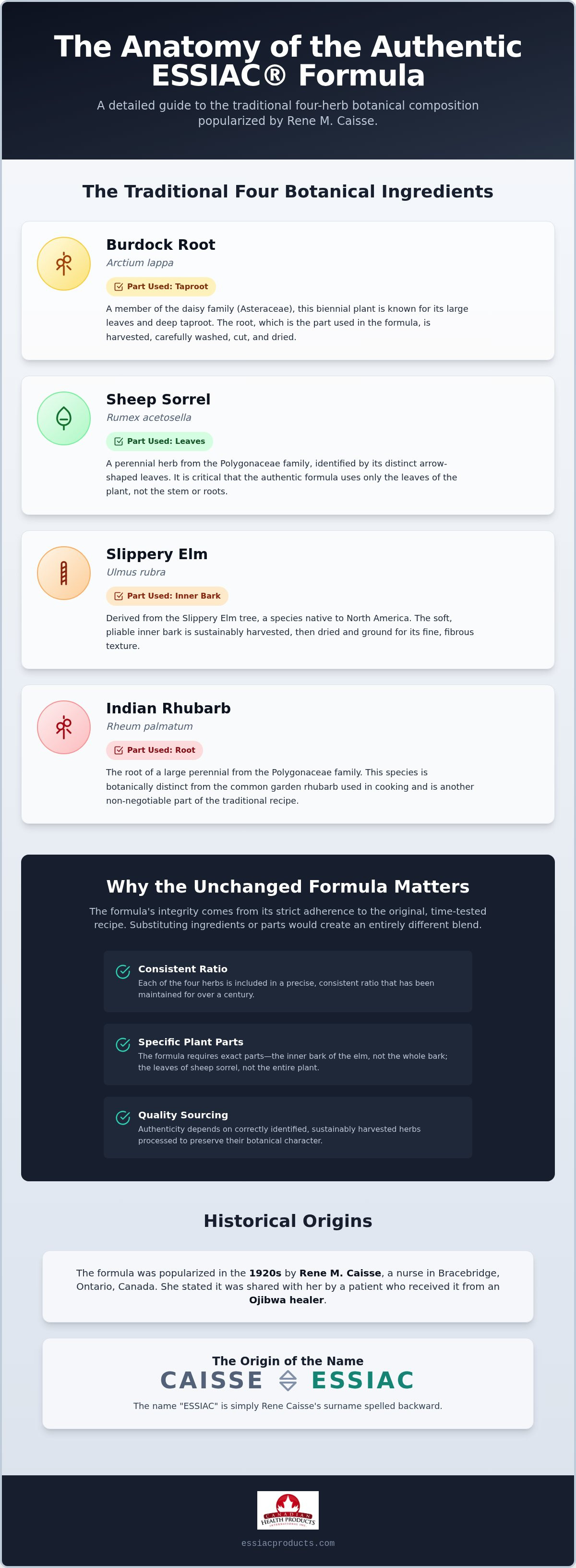
The original Essiac formula is a precise blend of four specific botanical ingredients, maintained in a consistent ratio. This composition is not random; it is the result of a recipe that has been carefully preserved for over a century. The integrity of the formula depends on using not only the correct plants but also the correct parts of those plants, sourced and prepared according to traditional standards.
- The blend consists of Burdock root, the leaves of Sheep sorrel, Slippery elm inner bark, and Indian rhubarb root.
- Each component is selected for its distinct botanical properties and its place in the formula’s history.
- Maintaining the integrity of this four-herb ratio is fundamental to producing the authentic Essiac preparation.
- The name "Essiac" itself is the surname of its originator, Caisse, spelled backward, a constant reminder of its specific lineage.
Why the Four-Herb Ratio Matters
The formula's consistency since the 1920s is a cornerstone of its identity. Unlike many modern herbal mixtures that are frequently altered or "improved," the Essiac blend's value lies in its adherence to the original, time-tested recipe. This commitment extends to the specific parts of each plant used.
For example, the formula requires the inner bark of the Slippery elm, not the whole bark, and only the leaves of the Sheep sorrel plant, not the root or stem. This level of specificity is crucial. Each part of a plant has a different botanical makeup, and substituting one for another would create a different formula altogether. This precision ensures that every batch is as close as possible to the one Rene Caisse prepared. You can explore the authentic preparations in the Essiac Tea Collection.
Identifying Genuine Ingredients
When dried and blended, the four Essiac herbs have a characteristic appearance. The mixture is typically a fine powder or a coarse-cut blend of dark, light, and reddish-brown plant materials. Burdock root often appears as small, dark pieces, while Slippery elm inner bark is lighter and has a fibrous texture. The deep red-brown of Indian rhubarb root and the greenish fragments of Sheep sorrel leaves complete the blend.
Quality sourcing is paramount to maintaining this traditional formula. Reputable suppliers work to ensure that the herbs are correctly identified, harvested from sustainable sources, and processed in a way that preserves their botanical character. This diligence is the first step in ensuring the authenticity of the final product.
Botanical Profiles: Understanding the Plant Ingredients
A deeper understanding of the Essiac tea ingredients begins with their botanical identities. Using the correct scientific names helps eliminate confusion with other, similar-looking plants and confirms the use of the precise species required by the original formula.
- Burdock Root (Arctium lappa): A member of the Asteraceae family (the daisy family), this biennial plant is known for its large leaves and deep-reaching taproot, which is the part used in the Essiac formula.
- Sheep Sorrel Leaves (Rumex acetosella): A perennial herb from the Polygonaceae family, characterized by its distinct arrow-shaped leaves. It is crucial to note that the authentic formula uses only the leaves of the plant, not the entire herb or its roots.
- Slippery Elm Inner Bark (Ulmus rubra): Derived from the inner bark of the Slippery Elm tree, a species native to North America. This material is known for its fine, fibrous texture.
- Indian Rhubarb Root (Rheum palmatum): The root of a large perennial from the Polygonaceae family. It is botanically distinct from the common garden rhubarb (Rheum rhabarbarum) used in cooking.
Arctium Lappa and Rumex Acetosella
Burdock (Arctium lappa) is a robust plant that typically flowers in its second year. Its taproot can grow over two feet deep, anchoring it firmly in the soil. Harvesting this root is a labor-intensive process that must be done at the right time to ensure the plant’s material is at its intended state. Once harvested, the root is carefully washed, cut, and dried for use in the herbal blend.
Sheep sorrel (Rumex acetosella) is a common plant found in fields and open spaces across Canada and other parts of the world. Its leaves are easily identified by their unique arrowhead shape. For the Essiac formula, the careful and exclusive harvesting of these leaves is a critical detail that distinguishes the authentic recipe from variations that may incorrectly use other parts of the plant.
Ulmus Rubra and Rheum Palmatum
The Slippery Elm (Ulmus rubra) tree has a long history of use in North America. The process of harvesting its inner bark must be done sustainably to avoid harming the tree. Harvesters make careful incisions to remove sections of the outer bark, then peel away the mucilaginous inner layer. This soft, pliable inner bark is then dried and ground for inclusion in the Essiac formula.
Indian Rhubarb (Rheum palmatum) is a large, leafy plant with a thick, fleshy root system. It is a different species from the rhubarb found in grocery stores and gardens. The roots of Rheum palmatum are substantial and have a distinct morphology and color that make them identifiable to trained harvesters. The use of this specific rhubarb species is another non-negotiable aspect of the traditional recipe.
The Historical Journey of the Rene Caisse Formula
The story of Essiac is inseparable from the life of Rene M. Caisse, a Canadian nurse from Bracebridge, Ontario. In the 1920s, she began preparing the four-herb formula, which she stated was shared with her by a patient who had received it from an Ojibwa healer. This connection to traditional Indigenous knowledge is a foundational part of the formula's heritage.
- The formula was popularized in the 1920s by Nurse Rene Caisse.
- Its origins are traced to traditional knowledge from an Ojibwa healer in Northern Ontario.
- The name 'Essiac' is a simple palindrome of Caisse's surname.
- Rene Caisse dedicated much of her life to preparing and providing the herbal blend, working tirelessly from her clinic in Bracebridge.
Rene Caisse and the Ontario Legacy
For decades, Rene Caisse was the sole keeper of the Essiac formula. She harvested and sourced the herbs herself, preparing the blend in her own kitchen. Her work in Bracebridge became well known throughout the region, and the history of her efforts is documented in local archives and personal correspondences.
The preservation of the four-herb recipe was of utmost importance to her. She resisted numerous attempts to buy the formula, fearing it would be altered or commercialized in a way that compromised its integrity. It was only late in her life that she passed the rights to the formula on, ensuring its survival beyond her lifetime.
From Tradition to International Distribution
The transition from a small-batch preparation in a Canadian town to a standardized, internationally available product was a slow and careful process. After Rene Caisse's passing, the formula was entrusted to parties who had worked with her and understood her commitment to quality. Essiac Canada International became the steward of this legacy, tasked with maintaining the original standards of production.
Today, the formula is produced in larger quantities, but the core principles remain the same: using the correct four herbs, in the correct ratio, with a focus on quality sourcing. This allows individuals around the world to access the same formula that Rene Caisse prepared in Bracebridge nearly a century ago.
Comparing Modern Essiac Formats and Preparation
While the herbal formula itself has not changed, the ways it can be consumed have evolved to suit different needs and lifestyles. The authentic blend is available in three primary formats: a traditional powdered tea, convenient vegetable capsules, and a concentrated liquid extract. Each format contains the same four-herb combination, but they differ in preparation, convenience, and storage.
- Traditional Tea: The powdered formula requires a specific brewing and steeping process to prepare a liquid that is stored in the refrigerator.
- Vegetable Capsules: Encapsulated powder offers a convenient, shelf-stable alternative that requires no preparation.
- Extract Formula: A concentrated liquid provides a ready-to-use option that can be mixed with water or juice.
- Storage requirements vary by format, with the brewed tea needing refrigeration while capsules and extracts are kept in a cool, dry place.
Tea vs. Capsules: Convenience and Storage
The choice between tea and capsules often comes down to personal preference and daily routine. Preparing the Essiac Tea Powder involves a precise, multi-step process of boiling and steeping, which many users find to be a mindful ritual. The resulting liquid must be kept in a light-proof container in the refrigerator and is typically consumed over a period of two to three weeks.
In contrast, Essiac Vegetable Capsules contain the same powdered herbal blend in a pre-measured, easy-to-swallow format. They are shelf-stable, portable, and require no preparation, making them a practical choice for those with busy schedules or who travel frequently. Both formats deliver the same core ingredients; the only difference is the method of consumption.
Extracts and Specialized Options
The Essiac Extract Formula offers a third option. This format is an alcohol-free, concentrated liquid that can be quickly mixed into a beverage. It eliminates the need for brewing and provides the convenience of a ready-made product. Like the capsules, it is shelf-stable until opened.
In addition to these formats for human use, a specialized product line, Essiac for Pets, is also available. These products use the same traditional four-herb formula in dosages and formats designed specifically for animal wellness, such as smaller vegetable capsules.
Frequently Asked Questions About Essiac Ingredients
Here are answers to some of the most common questions regarding the composition and history of the Essiac formula.
What are the four main ingredients in Essiac tea?
The four traditional ingredients in the authentic Essiac formula are Burdock root, Sheep sorrel leaves, Slippery elm inner bark, and Indian rhubarb root.
What is the botanical name for the herbs in the Essiac formula?
The botanical names for the four herbs are: Arctium lappa (Burdock), Rumex acetosella (Sheep sorrel), Ulmus rubra (Slippery elm), and Rheum palmatum (Indian rhubarb).
Who was Rene Caisse and what is her connection to the formula?
Rene M. Caisse was a Canadian nurse who, in the 1920s, began preparing and distributing the four-herb formula. She received the recipe from a patient who had learned of it from an Ojibwa healer. Caisse dedicated her life to preserving and providing the formula, and its name, "Essiac," is her surname spelled backward.
Is there a difference between the tea and the capsule ingredients?
No, the core herbal ingredients are the same in both the traditional tea and the vegetable capsules. The only difference is the format and method of consumption. The tea is a loose powder that you brew into a liquid, while the capsules contain the same powder in a pre-measured, plant-based shell.
How should the different formats of Essiac be stored?
Once prepared, the brewed Essiac tea must be stored in a sealed, light-proof container in the refrigerator and used within three weeks. The powdered tea, vegetable capsules, and liquid extract are all shelf-stable and should be stored in a cool, dry place away from direct sunlight before being opened.