

What Are the Four Ingredients in Essiac Tea?
The Essiac® formula is defined by its simplicity and precision. At its core are four specific herbs, prepared in a traditional manner that has remained unchanged for decades. Understanding these core components is the first step in recognizing the authentic formula developed by Canadian nurse Rene M. Caisse.
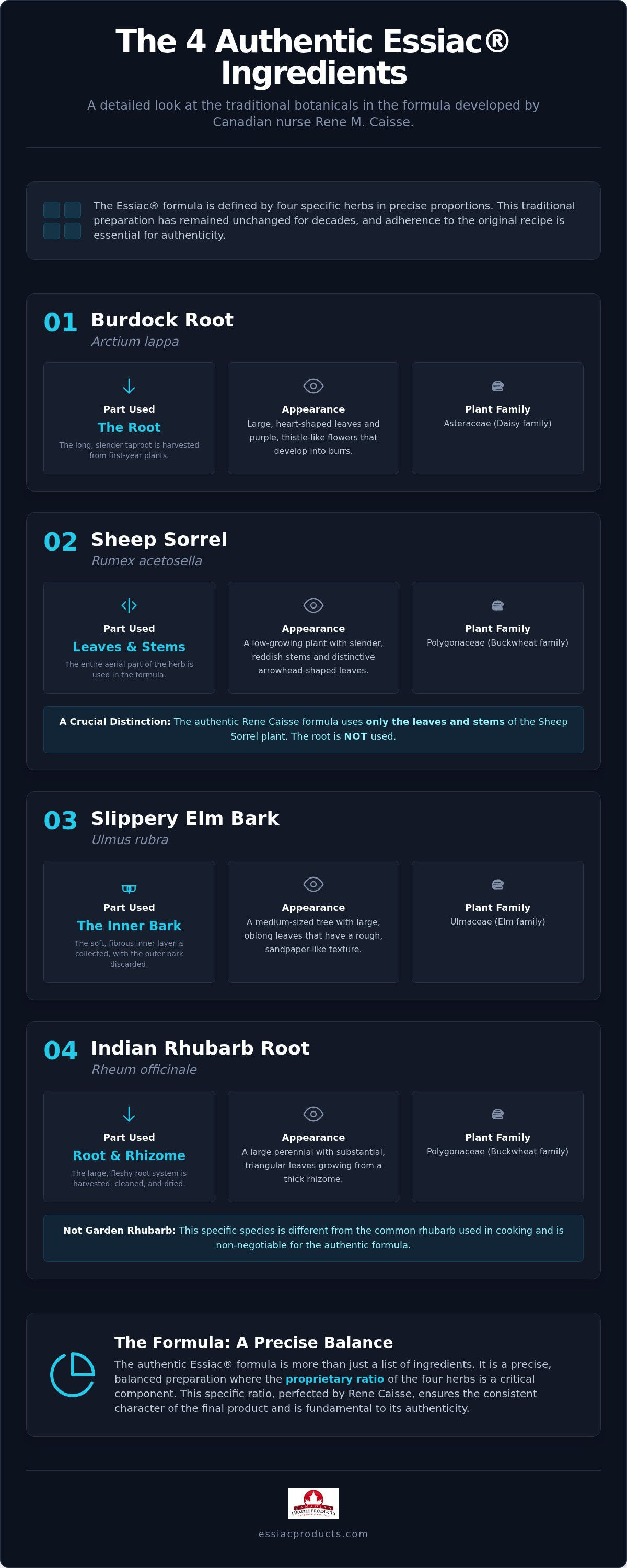
The four traditional ingredients in Essiac® tea are Burdock Root, Sheep Sorrel leaves, Slippery Elm bark, and Indian Rhubarb root. These are not just four random herbs; they are the specific botanicals, in the specific proportions, that constitute the original formula. Each ingredient is selected for its unique characteristics, and their combination is the result of years of refinement.
This guide provides a detailed look at each of the four Essiac tea ingredients. We will explore the botanical identity of each herb, the specific part of the plant used, and why adherence to the original four-herb recipe is essential for authenticity. We will also clarify common points of confusion, such as the difference between four-herb and eight-herb formulas, to help you make an informed choice.
A Closer Look at the Four Essiac® Ingredients
The enduring legacy of the Essiac® formula is rooted in its consistent, four-herb composition. Each herb is sourced and prepared according to strict quality standards to ensure the final product aligns with the one Rene Caisse entrusted to the public. Let's examine each of these botanicals in detail.
1. Burdock Root (Arctium lappa)
Burdock is a large, hardy plant belonging to the Asteraceae family, which also includes daisies and sunflowers. It is recognized by its large, heart-shaped leaves and burrs that cling to clothing and animal fur. While it grows wild across North America, Europe, and Asia, it is also cultivated for its culinary and herbal uses.
Botanical Characteristics:
- Plant Family: Asteraceae/Compositae (Daisy family)
- Appearance: A biennial plant that forms a rosette of large, wavy-edged leaves in its first year. In its second year, it sends up a tall, branching flower stalk that can reach heights of over five feet, producing purple, thistle-like flowers that develop into the well-known burrs.
- Part Used in Essiac®: The root. The long, slender taproot is harvested from first-year plants. It is grayish-brown on the outside and whitish on the inside. Its appearance is similar to a parsnip or carrot.
In the context of the Essiac® formula, the careful harvesting and processing of the burdock root are paramount. The quality of the raw material directly influences the final preparation, which is why sourcing from trusted growers who adhere to high standards is a non-negotiable part of the production process.
2. Sheep Sorrel Leaves (Rumex acetosella)
Sheep Sorrel is a small, perennial herb from the Polygonaceae family, which also includes buckwheat and rhubarb. It is a common plant found in fields, grasslands, and disturbed soils across much of the world. It is easily identified by its distinctive arrowhead-shaped leaves and a sharp, tangy taste.
Botanical Characteristics:
- Plant Family: Polygonaceae (Buckwheat family)
- Appearance: A low-growing plant with slender, reddish stems that can reach about 18 inches in height. Its most notable feature is its bright green, arrow-shaped leaves. It produces tiny, reddish flowers in tall spikes during the spring and summer.
- Part Used in Essiac®: The leaves and stems (the whole aerial part of the herb).
A crucial point of distinction for the authentic Essiac® formula lies in the use of the Sheep Sorrel plant. The original, time-tested formula developed by Rene Caisse uses only the leaves and stems of the Sheep Sorrel plant. The root is not used. This is a fundamental aspect of the recipe passed down by Caisse and her collaborators. Formulations that include the root deviate from this original preparation. Adherence to using only the aerial parts of the herb is a key marker of authenticity and a commitment to preserving the formula exactly as it was intended.
3. Slippery Elm Bark (Ulmus rubra)
The Slippery Elm is a medium-sized deciduous tree native to eastern and central North America. It is a member of the Ulmaceae family and is also known as Red Elm or Moose Elm. The tree is valued for its strong, durable wood and, most notably, for its mucilaginous inner bark.
Botanical Characteristics:
- Plant Family: Ulmaceae (Elm family)
- Appearance: The tree can grow up to 60-70 feet tall, with a trunk that is often forked. The leaves are large, oblong, and have a rough, sandpaper-like texture on the upper surface. The "slippery" quality comes from the inner bark, or phloem, which contains large cells that swell when mixed with water.
- Part Used in Essiac®: The inner bark. The outer bark of the tree is discarded, and the soft, fibrous inner layer is carefully collected and powdered. This process requires skill to ensure the health and sustainability of the tree.
The quality of Slippery Elm bark can vary significantly based on harvesting time and methods. For the Essiac® formula, only high-quality inner bark from reputable sources is used to ensure the consistency and character of the final product.
4. Indian Rhubarb Root (Rheum officinale)
This ingredient often causes confusion, as it is not the same as the common garden rhubarb used in pies (Rheum x hybridum). The herb used in Essiac® is a specific species of rhubarb, sometimes known as Turkey Rhubarb, that has a long history of use in traditional Chinese preparations. It is also a member of the Polygonaceae family, like Sheep Sorrel.
Botanical Characteristics:
- Plant Family: Polygonaceae (Buckwheat family)
- Appearance: A large, herbaceous perennial with large, triangular leaves that grow from a thick rhizome. It produces tall flower stalks with numerous small, greenish-white to pinkish flowers.
- Part Used in Essiac®: The root and rhizome. The large, fleshy root system is harvested, cleaned, dried, and then ground into a fine powder for use in the formula.
The use of this specific rhubarb species is another non-negotiable component of the authentic formula. Substituting it with common garden rhubarb would fundamentally alter the preparation. This highlights the importance of precise botanical identification in crafting the genuine Essiac® tea.
The Formula: More Than Just a List of Ingredients
Understanding the four Essiac tea ingredients is only part of the story. The authentic formula is not a simple mixture but a precise, balanced preparation. The specific ratio of the four herbs to one another is a critical component of the recipe. This proprietary ratio was perfected by Rene Caisse and has been kept confidential to protect the integrity of the formula.
This careful balance ensures that the final brewed tea has the consistent character that defines Essiac®. Altering the ratios or adding or subtracting ingredients would result in a completely different product, not the traditional formula that has been trusted for nearly a century. This is why the combination of the herbs is just as important as the herbs themselves.
Quality Control and Sourcing: The Unseen Factors
Beyond the four herbs themselves, several unseen factors are critical to producing authentic Essiac®. The quality and purity of the raw ingredients are paramount. This involves a commitment to rigorous sourcing and quality control standards.
- Source Verification: Each herb is sourced from reputable growers who can verify the botanical identity and quality of their plants.
- Purity Testing: The herbs are tested to ensure they are free from contaminants such as pesticides, heavy metals, and microbes.
- Non-Irradiated Herbs: The herbs used in authentic ESSIAC® are not irradiated, a process that can sometimes be used to sterilize botanicals but which many consumers prefer to avoid.
- Good Manufacturing Practices (GMP): The entire production process, from blending the herbs to packaging the final product, takes place in facilities that adhere to GMP standards. This ensures a safe, consistent, and high-quality product every time.
These behind-the-scenes steps are an integral part of the formula. When you choose a product, you are also choosing the quality standards it was made with.
The Traditional Four-Herb Formula vs. Eight-Herb Variants
Consumers exploring Essiac tea will often encounter "eight-herb" formulas. It is important to understand the distinction between these and the original recipe. The authentic formula, as documented and passed down by Rene Caisse and her close associate, Dr. Charles Brusch, consists of the four herbs detailed above: Burdock Root, Sheep Sorrel leaves, Slippery Elm bark, and Indian Rhubarb root.
The eight-herb formulas are a later variation introduced by others and include additional ingredients like watercress, blessed thistle, red clover, and kelp. While these herbs have their own histories, they are not part of the original Essiac® preparation. For those seeking the formula with direct ties to Rene Caisse's work, the four-herb version is the historically documented one. You can learn more about this in our detailed comparison of Essiac® vs. other herbal teas.
How to Identify Authentic Essiac® Ingredients
As a consumer, your best tool for verification is the product label. When looking for the authentic Essiac® formula, here is what to check for:
- The Four-Herb List: The ingredient list should clearly state only the four traditional herbs: Burdock Root (Arctium lappa), Sheep Sorrel leaves (Rumex acetosella), Slippery Elm bark (Ulmus rubra), and Indian Rhubarb root (Rheum officinale).
- The ESSIAC® Trademark: Look for the registered trademark ESSIAC®. This is a sign that the product is made by the company with direct lineage to the original formula and meets the established quality standards.
- No Extra Ingredients: The authentic formula does not contain any other herbs, fillers, or artificial additives.
- Company History: Choose a provider with a clear, verifiable history connected to Rene Caisse and her legacy. Authenticity is rooted in this unbroken chain of stewardship.
By checking for these markers, you can be confident that you are purchasing the traditional, four-ingredient formula. The ESSIAC® Herbal Tea Powder is the foundational product, containing the precise blend of these four herbs, ready for traditional preparation.
Conclusion: A Legacy of Four Herbs
The four ingredients in Essiac® tea—Burdock Root, Sheep Sorrel leaves, Slippery Elm bark, and Indian Rhubarb root—form the foundation of a legacy that has spanned nearly a century. This is not just a list of botanicals, but a specific, time-honored formula defined by precise ingredients, proprietary ratios, and rigorous quality standards.
From the critical detail of using only Sheep Sorrel leaves to the careful sourcing of each root and bark, every element is a testament to the commitment to authenticity. By understanding these core components, you can better appreciate the history and consistency of the formula and make an informed decision based on the facts of the original preparation. To learn more about the complete history and context, please see our comprehensive guide, What is Essiac® Tea?